Friday, 10 July 2015

Observations and proposals on the NDP armoured column rehearsal

Some quick points of interest regarding the NDP armoured column rehearsals, which will run every Saturday until the 9th of August:

The vehicles are low-loaded or driven to the form-up point for the column at the carpark next to Leisure Park Kallang overnight, and around 12pm is a good time to see them moving off.


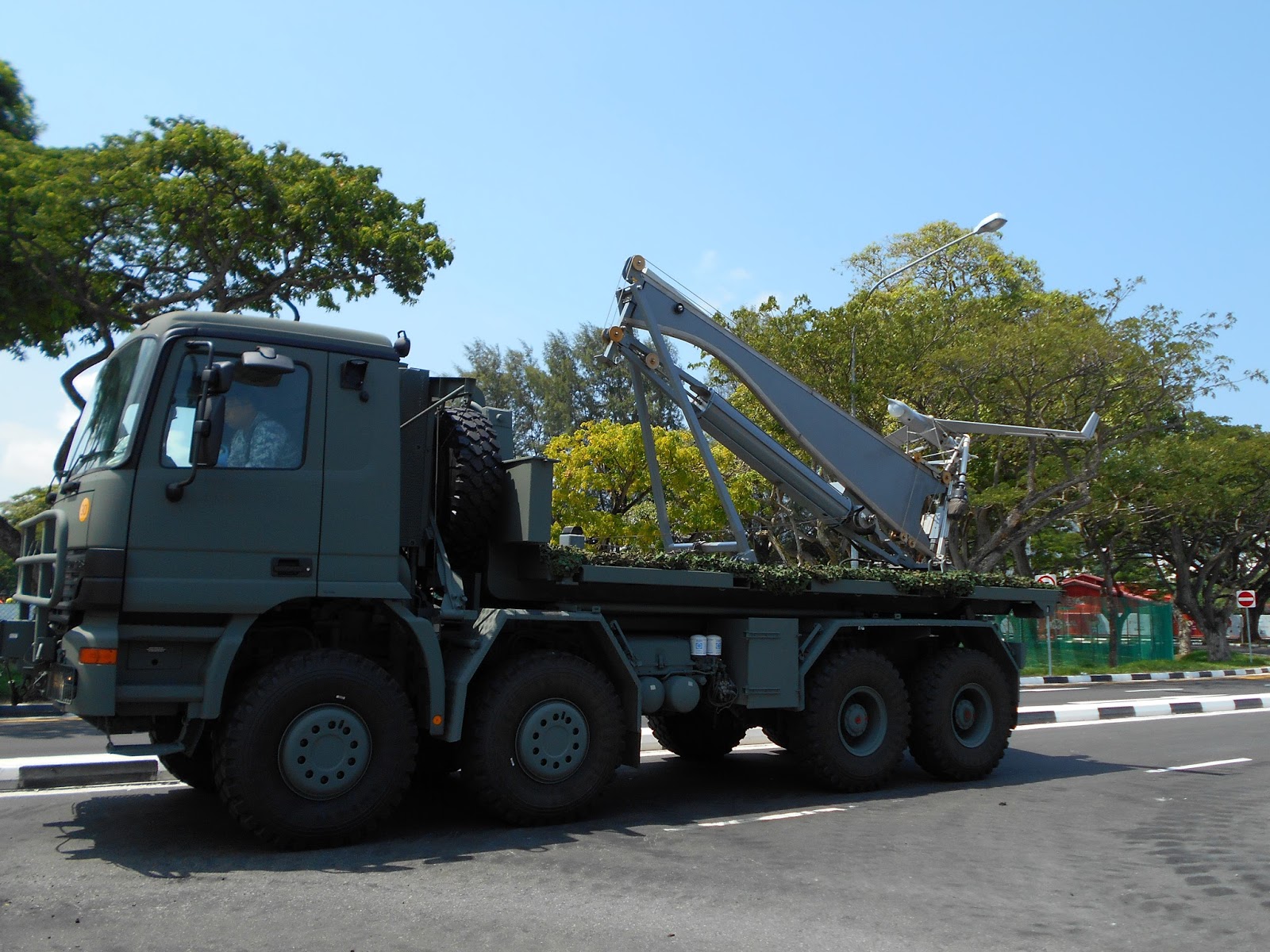


The packet information on the vehicles lets one get an idea of the work needed to position even this small cross-section of Singapore's military and civil defence vehicles in place.


As usual, the carpark is not cordoned off, and a fair few members of the public have taken the opportunity to get up close and personal with the column and speak to the soldiers and Home Team personnel manning them.


While vehicle commanders from the Army dismounted to guide their vehicles around tight bends, strangely, the Air Force M113 Igla group negotiated it straightaway rather than stopping to let the vehicle commander out. leading to one or two close scrapes with the pavement. The view isn't the best from the driver's compartment, and it was rather surprising to your author who was trained in armoured infantry. Perhaps it is standard practice in the Air Force, considering the marshallers directing traffic didn't bat an eye.


If you're around town, the column does a turnaround at about 2pm, leaving plenty of opportunity for a second round and views from overhead bridges.


Further and more detailed coverage can be found on the excellent Kementah blog.

Considering that pioneering servicemen are taking part in the parade, I can't help but wonder if an opportunity was missed to bring vehicles now out of service out for the column. I'm perhaps influenced here by the Russian practice of keeping historical vehicles such as T-34 tanks in their Victory Day parades.

Quite apart from their historical value, they would also highlight the changes in the SAF ORBAT and Home Team's capabilities. The infantry, for instance, now has the Terrex to showcase, where in previous years they were mounted on tonners! (The column starts at 53:13, led by the then-new Bionix 1, which has been fully displaced from recent mobile columns.)


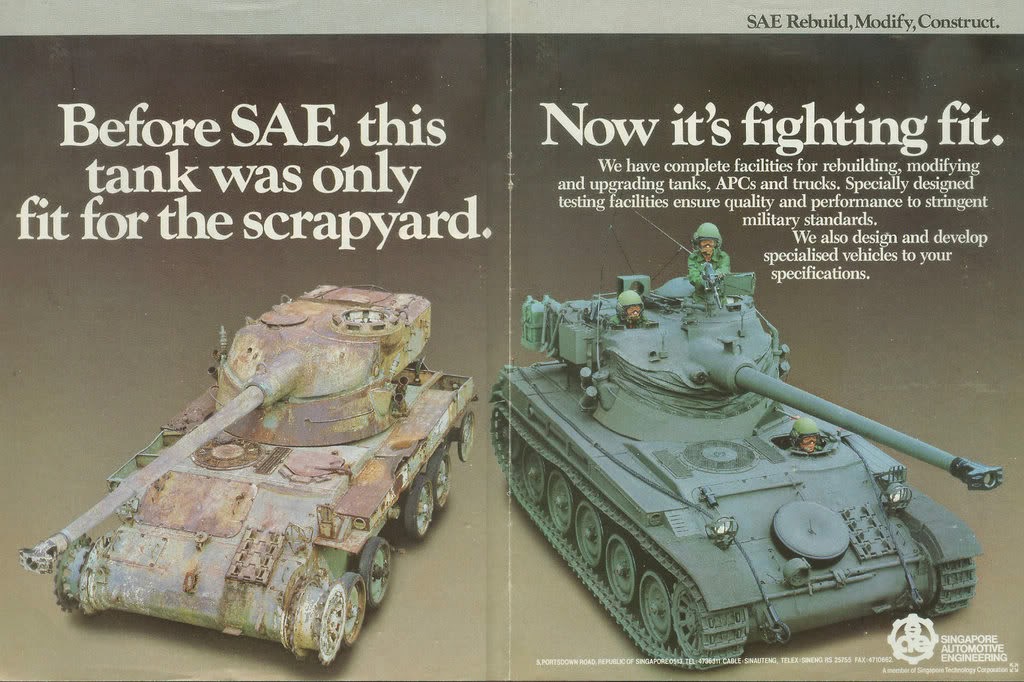
I'm not too clear on the state of the vehicles -  I want to say older vehicles are still kept around, but I do know that much of certain fleets have been disposed of. In a pinch sourcing surplus in a pinch M113s and AMX-13s from abroad would not be terribly difficult, although they would need at the very least external visual modifications.

Finding operators and drivers wouldn't be terribly difficult; if not ROD-ed NSmen, regulars could also be tapped. Some of the warrant officers I met in my NSF days had been in armour since the pre-M113 Ultra days. I am sure that such a proposal wouldn't have slipped the committee's mind, but it is a shame that it did not come to pass.

On the subject of NS matters - another thing that's always tickled me about these columns is that NSmen spectators would be perfectly capable of driving and operating a large number of these vehicles, and it was a bit of a shame that this wasn't brought across. I personally felt like giving directions to some of the more beleaguered RSAF M113 drivers. The logistics of, say, manning half the vehicles with NSmen would be something new, but it would be quite a testament to the capabilities of the NS system and speak to the true nature of the Army's order of battle.

Another part of the SG50 NDP I'm looking forward to is the air flypast - post-2000 flypasts have been a bit muted, and this year's one looks like a return to the glory old days. The RSAF is certainly practicing hard here - instead of confining practices to weekends, they are flying almost every day.

Wednesday, 17 June 2015

Everything but the kitchen sink - some reflections on undergrad history

I recently completed my undergraduate history course - while I have yet to officially graduate, finals exams are behind me.

During the past three years, I had the chance to choose from a menu of papers to read, and when picking them I had an eye towards whether they offered the potential for studying warfare and the military - such as on the US Civil War, or one paper that promised the chance to examine the Wars of the Roses. I also had the opportunity to write an undergrad thesis, which I did on the Singaporean military.

Unfortunately for me, I tended to come away particularly unsatisfied from most of them - it seemed that tutors were ready to cover everything about the war save the war itself. Most inquiry and eventual exam questions, even in papers ostensibly about a conflict, concerned themselves about the origins and effects of conflict itself, rather than studying battle or militaries. At its worst, some authors treated actual war as something akin to a natural disaster that served only to remove territory and important historical figures from the scene. While we might seek to consider the role war played in gender or the economy, the fighting itself sometimes came divorced from our study. In short - it seemed like everything regarding conflict was worth studying, except how to fight and win.

Now, I'll have to admit that I ought to have been more assertive in requesting to cover explicitly military-related aspects, and some papers handled that deftly. I will never forget Dr Gregory from Pembroke, who physically demonstrated the importance of convoying in the First World War with the use of scattered coins. In general I was honestly impressed at the quality of the First World War teaching. Still, I was told once that military history was sort of an 'intellectual dead end', and most discussion on combat and warfare quickly fell off the rails thanks to a general lack of knowledge. I didn't take this to heart, but that genuinely got me thinking about why it was.

Historians write of course based on their own interests, but also with an eye to wider publication, or to aid in solving serious historical questions. The study of war and combat proper seems to me to have acquired a cachet of 'popular history' for the casual reader, or for selected generals to read in Staff colleges.

Why would it not be popular? After all, armed clashes are riveting stuff for good reason, with the lives and stakes involved -  I daresay case-studies of conflict are certainly easier to relate to than most sub-fields of history. In addition, I'd suggest that the hard-science and engineering background of the modern Western and US military establishment has tinged anglophone academic study of the military in rather technical terms, a la Zaloga and other Security Studies works.

Hopefully I'll get to meet more military historians proper in the future and read what I can.


Wednesday, 8 April 2015

The early formulation of Singapore's defence policy


There are a couple of assumptions regarding post-independence Singapore's military history that die hard. I wrote my thesis on Singaporean defence in the post-independence period just last term, and to be honest it was really in reaction to some of these.

It was hardly inevitable to go from a practically disarmed island nation to the 'poison shrimp' concept, and later on to today's amply equipped SAF and its potential for preemptive strikes.

Firstly, the notion that Singapore was "abandoned" in defence after 1965 is seductive but false. The United Kingdom certainly caught the Singaporean leadership by surprise when it moved up its withdrawal schedule due to domestic concerns, with the PAP government ramping up negotiations behind the scenes as soon as it heard word and PM Lee Kuan Yew flying to London for talks as soon as the news broke publicly.

Nevertheless, the UK and the ANZAC states still had a vested interest in the stability of Malaysia and Singapore. There were a veritable raft of reasons. The UK still had commercial interests in Malaysia, with mining and plantation even more important in economically depressed times. The specter of Konfrontasi was fading, but  having handed power over to friendly local elites, Whitehall and civil servants in London and on the ground in Southeast Asia would certainly do all they could to ensure their safety against Communist or other subversion. There was also the possibility of using military facilities in Singapore (or Malaysia) for force projection.  As for the ANZAC nations, the concept of 'forward defence' of fighting the Communist menace in Southeast Asia before it reached Australian or New Zealand shores was in vogue.

Thus, the Five Power Defence Arrangements were negotiated to provide a framework for a joint Malaysian-Singaporean defence. Its chief instrument was a joint Malaysian-Singaporean integrated air defence system, aided by an Australian squadron of fighters, and for some years British and ANZAC troops deployed to the region and conducted exercises. Singapore's fledging military also benefited substantially from UK and Commonwealth collaboration for many years to come. In addition, British and other Commonwealth arms companies were eager to do business with Singapore. The island could have continued its defence collaboration with the UK/Commonwealth. Further collaboration was eventually abandoned in favour with other more cooperative partners, but to say that Singapore built up its defences in reaction to a 'British abandonment' is only a very small part of the story.

Secondly, would the territorial integrity of the island nation really be in question? We are constrained by a lack of information. The possibility of some sort of coup de main still remained, but the idee fixe common today of some sort of aggressive 'running amok' southwards would seem unlikely.

Having excised the 'cancer' of Communist Chinese subversion from the Federation by unanimously expelling Singapore, the expectation was that an independent Singapore would prove unviable and perhaps seek re-entry to Malaysia on Kuala Lumpur's terms. Some sort of forceful takeover would also be complicated by the presence of British and ANZAC troops. Besides, in the immediate term Malaysian troops were all over Singapore and Singapore's two infantry battalions had to divested of Malaysian personnel upon independence. With the mainland controlling Singapore's access to water and trade, was there really a need to even consider force?

Another thing I'd like to point out: even in separation, the governments of both Malaysia and Singapore still retained some enthusiasm for joint defence efforts, even if only in the name of defraying costs. The government in KL was not keen on devoting large amounts of GDP to defence, and a proposal was floated for Singapore to focus on providing naval defence for both nations, for example. The Lee cabinet's seeming profligacy in defence spending was greeted with some alarm by British Foreign Office negotiators!

Thursday, 19 March 2015

The myopia of deterrence

I've got coursework out of the way for the moment, and had this quick thought while catching up on news.

This is perhaps rather a basic question, but deterrence can't be considered in isolation. Militaries, being concerned with security, are particularly vulnerable to biased assessments of their own deterrence value. In Singapore, where the full might of the Army in particular will never be seen save full mobilization, I suspect the military is particularly prone to seeing itself as a 'doomsday weapon'.

An example of this intellectual laziness is in considering nuclear deterrence. MAD is sometimes dealt with as a field unto itself and held up as the supreme example of deterrence: the possession of nuclear weapons deters the escalation of conflicts. The destructive force of these weapons certainly went a long way in stopping superpower brinksmanship after some initial teething pains.

Still, consider a history that could have gone very differently. A Korean War where the US dropped one or two nuclear devices on the 'ChiComs' might have gotten the world used to kilo- or mega-deaths, and that the use of nuclear weapons was to be expected. Such a capability deterred war but no more than dreadnoughts or machine guns deterred war.

Such weapons made war more horrific and forced nations to build up the relevant capabilities to compete, but as soon as willingness to put lives on the line overcame merely material considerations they were moot. I won't even go into the obvious consideration that both sides of the Cold War simply sought other means to assail the other.

In the Singaporean context, Dr Bernard Loo has very simply applied the 'deterrence paradox' to Singapore multiple times - by definition it is difficult to prove that deterrence works. The pure existence of a military force does not mean that it has accomplished its mission.

To give a few other weaknesses of the argument for military deterrence; when an potential aggressor nation seeks to enforce its claims upon another, internal reasons for doing so are likely equally as important as external. Argentina pursued its claims over the Falklands partly due to the need for internal stability, and today China's claims over the South China Sea are partly motivated by internal politicking. Political scientists' models will definitely prove instructive here.

Moreover, purely military force may not be able to exercise control over overseas regions that may prove vital to national safety. For example, investment partners in the Riau Islands and Brunei provide the massively overdeveloped island city of Singapore with important materiel. As Huxley writes, it's possible that armed force may one day be deployed to protect those vital jugulars someday, but it's clear that at present political means rather than explicitly military means secure their safety.

The purpose of a military, as always, is as a useful tool discharging a variety of functions, just like a police service, fire service or education service. Even in defeat the institution of a military can serve the role of a national rallying point - see the Free French, or more recently the Kuwati military in 1991. The military does itself a disservice by overly focusing on one aspect of its existence.

Security enthusiasts ought also overcome this strategic myopia - I suspect it arises out of the inner conflict between not wanting to see the military used, yet being proud of the national project of building armed force.

Saturday, 7 February 2015

What will be Singapore's next defining military export?

Singapore's indigenous arms industry is pretty successful by Southeast Asian standards. Say what you may about it, but the ST group of companies has gone beyond small arms and equipment maintenance, venturing into improving and finally developing entire weapons systems.

While exports have always been something of a sideshow, there have been several products that went on to achieve notable overseas sales. These have mostly stemmed out of breakthroughs made for Singapore's own armed forces. Quite interestingly, in the 1980s Singapore was for a time a global leader in AMX-13 and A4 Skyhawk upgrades. Among other successful exports have been patrol craft/boats, mortars and possibly ammunition.


A certain market also exists for refurbished ex-Singaporean weapons. For example, Fennec recce helicopters were reexported to Chad in 2008, and 120mm mortars to Sri Lanka in 2000.


The question really is whether there is a new product Singapore can hope to bring to the table. What is our new AMX-13? Our new A4? The Leopard 2 market is already saturated with upgrades from the West, and the same could be said for aircraft jamming pods and equipment. Upgrades to our Formidables and submarines could be possible, but the market for that is rather small. Not many use La Fayette class ships, and "tropicalisation" of submarines will be limited to the Southeast Asian market.


If I were pressed to tell you what's Singapore's present military export success, I honestly wouldn't be able to say. Lots of stuff has certainly been marketed - the Terrex, the SAR 21 rifle and ST Marine ship designs have all been pushed at trade fairs, in informal marketing, and so on. Singapore has a niche in low-cost lightweight field artillery, but has been stymied recently in India.

Interestingly, Singaporean small arms have never achieved much export success. The Ultimax light machine gun, designed by the famous Jim Sullivan, was perhaps the nation's greatest hope. When it hit the market in the late 1970s - early 1980s it had several unique qualities. The marketing focused on it being lightest LMG bar none at the time, with a clever campaign describing how it was light enough even for Asian women to handle. It was also relatively cheap and came with the Jim Sullivan brand-name.

 A simple googling of the name would also find much praise of the Ultimax from American gunowners even today - there are a few samples that were brought there still floating around the American market.  Nevertheless, it failed to strike pay dirt.


Small arms are a difficult market to compete in. Most nations with a decent industrial capacity should be able to make their own. It would have been unimaginable for the USMC to choose the Ultimax for their new squad automatic weapon over local manufacturers with which it had an enduring relationship with, for example. In something common to all weapons purchases, even if nations import they may well look to using weapons purchases to curry favour with a country instead, and the qualities of the gun become irrelevant.

There are exceptions, such as Jordan purchasing T91 rifles from Taiwan, but those often come about via strong defence diplomacy.

This is at its core a business question as much as it is a defence one, and I'm sure ST executives and others in the business of setting industrial policy in Singapore are well appraised of the global arms market and how Singapore must position itself. Personally, due to the nature of decision making, I'd say that in the military sphere defence diplomacy and strong marketing are just as important as the quality of the product itself. I'd daresay the Bronco sale to the United Kingdom, in response to an urgent requirement, was one of these.

Nevertheless, with the equipment which the SAF is using, future export prospects seem particularly dim.

Tuesday, 27 January 2015

Musings on 'peace advocacy' in popular culture


In lieu of a proper update;

I was in a bookshop during lunch reading some anti-war books warning about the bifecta of "modern culture" and the "military cultural complex" and how they interact to drive us toward destruction.

To be honest, I don't agree with most of their conclusions. For example, a lot of these writers - whose names I should have taken down - make the assumption that an interest in warfare (and killing, apparently) is something to be stamped out. In my opinion, for a society to have people interested in its defence is no bad thing, no worse than a lot of other activities out there.

However, I do think it's important to have these pundits around. In the Western world, military showdowns as a first choice to resolve inter-state disputes have lost much their shine after the two World Wars, and I personally think that's good. Such advocates often mean well, and their arguments are certainly needed in modern society.

Friday, 19 December 2014

Camp justice - we need more than legal statements


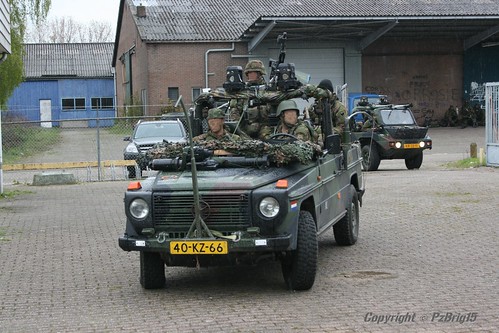
This case could potentially have been a very explosive one. Like it or not, the G-Wagen incident
involved spurious orders and unit culture and could have become a catchall for something many Singaporean conscripts would have experienced. The fact that a five-day safety timeout was ordered back then in 2012 might also mean that an astute staff team realized that deep issues had made themselves felt despite the SAF's avowed strong safety culture. 
MB-290 type jeep much like that involved
Nonetheless, the judge in this case has focused on the somewhat obvious principle that NSFs (conscripts) need not obey manifestly illegal orders. He even called on the officer representing Calvin Tan, the soldier driving the jeep, to "get the message out that national servicemen need not obey any such order."

(Admirably, the conducting officer has been charged as well.)

A "weak safety culture", as uncovered by the committee of inquiry, is one thing, but another deeper issue exists. 

The issue in this case in my opinion would be one of the military's culture. It is admirable and right to say that soldiers ought not to follow illegal orders. However, where's the protection for troops in this situation? What institutions guarantees soldiers' safety and welfare (not rights, not in Singapore) if they make a fuss? I only recall a cursory hour-long treatment of military law delivered one groggy evening in BMT, although I hope this has changed.

We aren't the Bundeswehr in this aspect, unfortunately. The German military's deeds in the Second World War and the ire it gained post facto, not to mention political expediency, led to an entire are of focus within the military quite foreign to most others. Now I don't want to simply praise the German military, and I ask any German readers your forgiveness and guidance if I have mischaracterized it. As far as I understand it, the princples of Befehl und Gehorsam, or the principle of command and obedience were first disseminated in the fifties. In general, it sought to reduce superiors' powers to compel subordinates and encouraged shared responsibility for obedience by subordinates.

For example, if a junior is unsure of his orders, he can verify them with his superior's superior, and can but need not obey in certain situations and must not in others. If the order is illegitimate and he carries it out, he has to take responsibility as well.

It's not just a set of broadly stated 'mission statements', too. I am unclear as to how well it is enforced in day-to-day operations, but there is a genuine commitment to this. For example, the Federal Republic and Germany today has no special military courts - all offences are tried in civilian courts. Such a stated goal can very easily break down, the military being a world apart, so constant care from the civilian sector and of course the military's own leadership is always needed. It may reduce flexibility in some instances, but this is but an aside point.

Stuff like this certainly won't solve being trapped in ire, say, if you do something unpopular but right, or choose not to compromise, but this is one's personal decision and you ought to defend it. It can however provide encouragement to question itself in a constructive manner, and empower conscripts rather than appealing to "man mode". On a more philosophical level, it's asking "why" rather than "how". Deeper change is needed than a judge's announcement and MINDEF press releases, which are simply treated with derision by HardwareZone and the like.

In the end, a refusal to confront such issues simply leads more to practices like displaying your license on the dash in lieu of real organizational shifts.


Frankly, this situation upsets your author because this was 3 3SG instructors in the back of a jeep tearing around the training grounds, one very familiar to me as a former spec. The last line of the article was even worse, and the reporter was clever putting the line about the "orders" in. I can only imagine what was really said.